Tuesday, September 13, 2022

Review - 'The Pukur' by DK Powell

First, an important fact:  ‘pukur’ is the Bengali word for a pool or pond, and the dark, brooding body of water, and the meanings that it bears for the individuals and the community that surround it, is at the centre of Ken Powell’s extremely fine coming-of-age novel set in rural Bangladesh; a position it shares with 12 year old Sophie Shepherd, the bereaved, vulnerable, abandoned, physically and emotionally wounded hero of the book, whose healing and growth the narrative charts with immense understanding, tenderness and intuitive sympathy.

Sophie’s story begins with the loss of her parents, and the disintegration of her life in the early chapters of the book makes for sometimes harrowing reading in a forbidding start to what is essentially a novel of joyful if hard-won self-realisation.  Powell’s great coup here, and what lifts ‘The Pukur’ into a different league from your typical YA dilemmas-of-teenage-life, is that Sophie’s recovery and development take place in the to her utterly alien society of rural Bangladesh, where she learns life as a ’third-culture kid’, in a deeply personal amalgamation of British and Asian experience mediated by the loving wisdom of women.  What shines through here is Powell’s self-evident love for and understanding of Bangladesh (where he lived for a number of years), and his descriptions of the country make enticingly fine writing.  There’s also real subtlety here – Sophie’s persistently difficult relationship with her prickly Uncle Joshua (for whom Powell is careful to show deep sympathy) enters a new dimension when they briefly travel to Dhaka and re-encounter British culture in the excruciating form of the local ex-patriates’ club.  

And Powell saves the best for last – the novel comes to a near-apocalyptic climax in the waters of the pukur when Sophie is faced with a challenge that will define her and her life.  I won’t say more about the denouement – but urge you to read this richly imagined and beautifully executed coming-of-age story. 

Sunday, August 28, 2022

Publication Day

It's publication day!
The Judas Case is dedicated to three very important people - Margaret, Harriet and Beatrice:
They'll be delighted if you buy a copy:
https://www.amazon.co.uk/Judas-Case-Nicholas-Graham/dp/191512252X

Friday, August 26, 2022

The Judas Case - ebook now available

More Judas news!

Pleased to announce that the ebook edition of The Judas Case has just dropped.
It's available now on Amazon, and also from other ebook distributors.
The perfect choice for bank holiday weekend reading:
Well, what are you waiting for?

Wednesday, August 24, 2022

Jesus in Fiction - Man Of Nazareth & The Judas Case

I blogged about Anthony Burgess' MAN OF NAZARETH last month - here

So I'm delighted to announce that the latest podcast from The Burgess Foundation has just dropped.  Join me and foundation director Andrew Biswell as we discuss Burgess’ biblical fiction MAN OF NAZARETH and my debut novel THE JUDAS CASE (published 28 August).

You can get the podcast now from the usual sources:

Acast:

https://shows.acast.com/anthonyburgess/episodes/christ-in-fiction

Apple:

https://podcasts.apple.com/gb/podcast/jesus-christ-in-fiction/id616742782?i=1000577185998

Spotify:

https://open.spotify.com/episode/2aO6MD6C7tzzuisYbV8gzq?si=T3MapYO0SPuQimtmwTRcgw&nd=1

and Youtube:

https://www.youtube.com/watch?v=KaZPBqgZUvM&feature=youtu.be

 THE JUDAS CASE paperback (ebook still to come) is available for purchase here:

https://www.amazon.co.uk/Judas-Case-Nicholas-Graham/dp/191512252X

And of course in all good bookshops.

Monday, August 22, 2022

Small Objects & Intimate Desires: Nicanor's Drinking Bowl

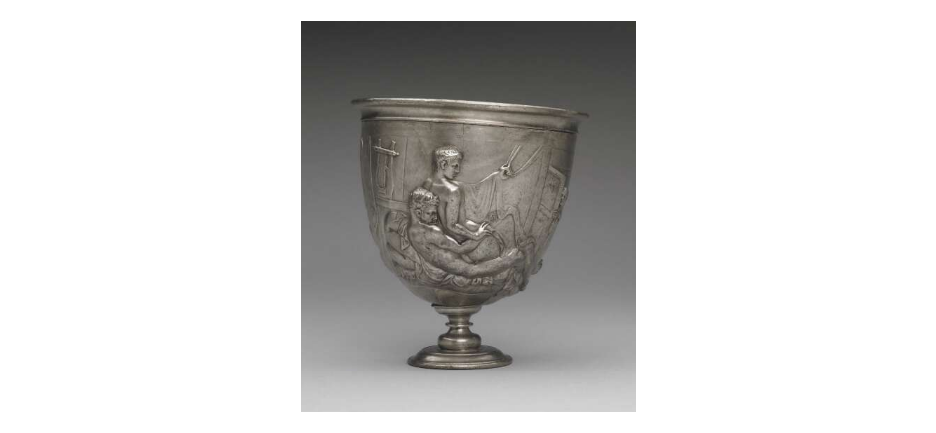
Early in the The Judas Case, Solomon is invited to dinner by his old friend Nicanor from Alexandria, and is intrigued by the silver cup from which the doctor drinks his wine:

The younger slave carried a tray with a ewer and a set of silver bowls, the grandest of which was set before Nico.  Engraved upon it was an image of a naked man taking his pleasure with a youth. They were both attached, in complicated ways, to an apparatus of ropes and slings.  My own bowl was unadorned. 

“A gift from a grateful client,” Nico said when he noticed my gaze.

The fictional cup could very well be mistaken for this one:


I’ll come back to this particular bowl in a moment, but first some background:

The ancient middle east was a society where material wealth was distributed so unevenly that it is difficult for us to understand its ramifications.  Almost all wealth was in the hands of about 2% of the population.  Practically everyone else – the vast majority illiterate rural peasants – was in a state of abject, persistent poverty, probably owning nothing but the cloth and sandals they stood up in and the food they would eat that day.  If they were lucky enough to have a trade, they might also own their tools. If there had been a good harvest they might retain enough grain to plant next year’s crop without having to sell their children to avoid starvation.  If you were one of the lucky 2% and either owned land, or followed a profession or traded in goods, you might accumulate or inherit surplus material possessions that you would feel to be ‘yours’.  Though the ever-present threat of theft, brigandage and the devastation of war might discourage you from projecting too much personal meaning onto an object other than as portable wealth that might hedge you against disaster (or bring you to the attention of robbers).

So writing characters in the ancient world presents a quite different challenge from that of novels set in the contemporary world of mass production, where domestic objects or material public wealth can more easily be used as a shorthand for social relations and as a way into a character’s interior life.  The fact that a twist in The Judas Case’s plot revolves around a linen robe – a garment of extreme luxury that gives Solomon a very specific clue about its wearer – is a deliberate exploitation of this reality.   I’ve been careful to portray Solomon and Zenobia (both with complicated backgrounds, both now just within a highly privileged minority that owns land and produces a valuable product) as just beginning to accumulate enough material wealth to feel a certain level of precarious security.  A wrap made from an expensive textile, an antelope-hair brush, a brooch with an image of the goddess Isis are notable ornaments, but they’re also small and light enough to be packed up in a hurry and carried to safety.  And I should admit at this point that it’s been authoritatively pointed out to me that Solomon’s preference for tunics of Egyptian cotton rather than hemp indicates a level of luxury that he and Zenobia have in other respects not yet attained. 

Nico’s drinking cup fits into this world of ancient signification too, and is notable because it, or its twin, exists in the archaeological record.  Go along to The British Museum in London and you can see it in Room 70.  It’s known as ‘The Warren Cup’ after a collector who owned it for a while, and it has attracted some controversy because of its subject matter and the suggestion (since refuted) that it may have been a modern fake.  It is dated to the early part of the 1st Century AD, and was found near Jerusalem at the beginning of the 20th Century.  It seemed to me to be just the sort of thing that Nico would use to serve a particularly good vintage either to a new lover or to honoured guests whom he could trust with his inner life. 

I should add that the historical cup was dug up in a village just outside of Jerusalem some distance from where I have located Nico’s house. The mystery of how the fictional cup came to this resting place – was it stolen by a disappointed conquest, or buried for safekeeping in turbulent times? – must await another Solomon Eliades mystery.     

Friday, August 19, 2022

Tuesday, July 12, 2022

A Clockwork Messiah? - Anthony Burgess' Man Of Nazareth reviewed

What’s it going to be then, eh?

There was me, that is Jesus, and my three meshuggeners, that is Pete, James and Johnny-Boy, Pete being rock-hard, and we sat in the Capernaum fish-shop . . .

 No, that’s not how Man of Nazareth begins, but I was struck by how Anthony Burgess’ Jesus and his disciples have something about them of Alex & the Droogs, as they set out on their mission to bring ultra-peace to Israel and all mankind.  And I was thrilled to be told by Burgess’ biographer that an early draft of the novel had indeed included disciples speaking a sort of 1st Century AD Nadsat.  More about that below. First, some context.

Burgess wrote Man Of Nazareth in the late 1970s just as archaeology was beginning to shed light on the mechanics of crucifixion (traditional iconography is almost completely physically and anatomically wrong); when deference towards organised religion was still default (the UK Christian right could prosecute Gay News for blasphemous libel over a poem); around the time of Python’s Life Of Brian (which Burgess loved); and long before a group of American biblical scholars calling themselves ‘The Jesus Seminar’ gathered to work their way through the gospels verse by verse and cast votes to determine which statements could be regarded as having historical reality (spoiler – more than you may fear, fewer than you may hope) in a sort of professorial democratic theology. 

So, how do you create space and time for a compelling fictional narrative when your sources are part polemical theology, part fabulist, and your readership’s ideas about history and truth are changing with the age?  Forty years and huge cultural change later, how does Man Of Nazareth strike a contemporary? 

Burgess announced at the time that he would approach the subject ‘seriously and reverently’ and he invents a narrator of his fiction, one Azor a professional storyteller writing some time after the events who is careful to begin by disclaiming authority and belief – he’s simply telling stories that he’s heard.  What Azor has heard, of course, is Burgess’ curation of gospel stories, with a very clear opening out of the political / historical background – much of the first half focuses on Herod, John The Baptist and Salome, and the extended family.  We also get three very Burgessian tropes -  musical disciples composing songs about their master’s teaching (one can only hope that the author’s own settings survive in the Burgess Archive), Roman soldiers swearing like droogs in multilingual barracks-room argot and, just as in A Clockwork Orange, Burgess’ profoundly serious grappling with free will and original sin. This last includes a brilliant passage on how the stain of original sin compels the Christian god to sacrifice himself.  I know far too little about St Augustine and Catholic apologetics to hazard a guess at Burgess’ source for this, but as internal polemic it makes brilliantly elegant sense without once diverting the narrative into creaking post-hoc rationalisation. 

The other marvellous thing about Burgess’ selection is how he develops Azor’s viewpoint and our understanding of its meaning.  The two great top-and-tail Johannine miracles serve to illustrate.  The water-into-wine at Cana is told as a straightforward magician’s confidence trick and Azor makes sure that we see through it. By the time we get to Bethany, Lazarus’ return from the dead is presented as unadorned, verified fact.

And Burgess (or rather Azor) saves the best twist to the very end, and I confess that I did not see it coming at all.  If you’re going to read one other historical Jesus novel (besides, of course, The Judas Case), I urge you to make it Man Of Nazareth – and don’t fast forward to the end.


Two curious asides:  has anyone ever contemplated writing either of these? 

An internal monologue-based fiction of Jesus’ thoughts and awareness from scourging to death - a sort of companion to Hermann Broch’s Death Of Virgil. 

The siege of Hippo, St Augustine surrounded by Vandals but hard at work on Civitas Dei and the end of classical culture in late antiquity.

Just a thought . . .

Whose Odyssey Is It Anyway?

You have to wait a long time for it, but there’s a decently good joke right at the end of Christopher Nolan’s Odyssey film.   It’s in the c...