Monday, August 22, 2022

Small Objects & Intimate Desires: Nicanor's Drinking Bowl

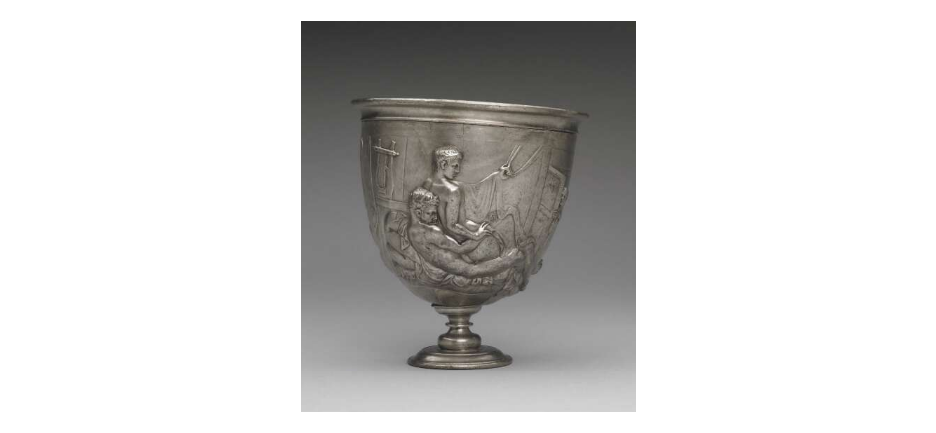
Early in the The Judas Case, Solomon is invited to dinner by his old friend Nicanor from Alexandria, and is intrigued by the silver cup from which the doctor drinks his wine:

The younger slave carried a tray with a ewer and a set of silver bowls, the grandest of which was set before Nico.  Engraved upon it was an image of a naked man taking his pleasure with a youth. They were both attached, in complicated ways, to an apparatus of ropes and slings.  My own bowl was unadorned. 

“A gift from a grateful client,” Nico said when he noticed my gaze.

The fictional cup could very well be mistaken for this one:


I’ll come back to this particular bowl in a moment, but first some background:

The ancient middle east was a society where material wealth was distributed so unevenly that it is difficult for us to understand its ramifications.  Almost all wealth was in the hands of about 2% of the population.  Practically everyone else – the vast majority illiterate rural peasants – was in a state of abject, persistent poverty, probably owning nothing but the cloth and sandals they stood up in and the food they would eat that day.  If they were lucky enough to have a trade, they might also own their tools. If there had been a good harvest they might retain enough grain to plant next year’s crop without having to sell their children to avoid starvation.  If you were one of the lucky 2% and either owned land, or followed a profession or traded in goods, you might accumulate or inherit surplus material possessions that you would feel to be ‘yours’.  Though the ever-present threat of theft, brigandage and the devastation of war might discourage you from projecting too much personal meaning onto an object other than as portable wealth that might hedge you against disaster (or bring you to the attention of robbers).

So writing characters in the ancient world presents a quite different challenge from that of novels set in the contemporary world of mass production, where domestic objects or material public wealth can more easily be used as a shorthand for social relations and as a way into a character’s interior life.  The fact that a twist in The Judas Case’s plot revolves around a linen robe – a garment of extreme luxury that gives Solomon a very specific clue about its wearer – is a deliberate exploitation of this reality.   I’ve been careful to portray Solomon and Zenobia (both with complicated backgrounds, both now just within a highly privileged minority that owns land and produces a valuable product) as just beginning to accumulate enough material wealth to feel a certain level of precarious security.  A wrap made from an expensive textile, an antelope-hair brush, a brooch with an image of the goddess Isis are notable ornaments, but they’re also small and light enough to be packed up in a hurry and carried to safety.  And I should admit at this point that it’s been authoritatively pointed out to me that Solomon’s preference for tunics of Egyptian cotton rather than hemp indicates a level of luxury that he and Zenobia have in other respects not yet attained. 

Nico’s drinking cup fits into this world of ancient signification too, and is notable because it, or its twin, exists in the archaeological record.  Go along to The British Museum in London and you can see it in Room 70.  It’s known as ‘The Warren Cup’ after a collector who owned it for a while, and it has attracted some controversy because of its subject matter and the suggestion (since refuted) that it may have been a modern fake.  It is dated to the early part of the 1st Century AD, and was found near Jerusalem at the beginning of the 20th Century.  It seemed to me to be just the sort of thing that Nico would use to serve a particularly good vintage either to a new lover or to honoured guests whom he could trust with his inner life. 

I should add that the historical cup was dug up in a village just outside of Jerusalem some distance from where I have located Nico’s house. The mystery of how the fictional cup came to this resting place – was it stolen by a disappointed conquest, or buried for safekeeping in turbulent times? – must await another Solomon Eliades mystery.     

Friday, August 19, 2022

Tuesday, July 12, 2022

A Clockwork Messiah? - Anthony Burgess' Man Of Nazareth reviewed

What’s it going to be then, eh?

There was me, that is Jesus, and my three meshuggeners, that is Pete, James and Johnny-Boy, Pete being rock-hard, and we sat in the Capernaum fish-shop . . .

 No, that’s not how Man of Nazareth begins, but I was struck by how Anthony Burgess’ Jesus and his disciples have something about them of Alex & the Droogs, as they set out on their mission to bring ultra-peace to Israel and all mankind.  And I was thrilled to be told by Burgess’ biographer that an early draft of the novel had indeed included disciples speaking a sort of 1st Century AD Nadsat.  More about that below. First, some context.

Burgess wrote Man Of Nazareth in the late 1970s just as archaeology was beginning to shed light on the mechanics of crucifixion (traditional iconography is almost completely physically and anatomically wrong); when deference towards organised religion was still default (the UK Christian right could prosecute Gay News for blasphemous libel over a poem); around the time of Python’s Life Of Brian (which Burgess loved); and long before a group of American biblical scholars calling themselves ‘The Jesus Seminar’ gathered to work their way through the gospels verse by verse and cast votes to determine which statements could be regarded as having historical reality (spoiler – more than you may fear, fewer than you may hope) in a sort of professorial democratic theology. 

So, how do you create space and time for a compelling fictional narrative when your sources are part polemical theology, part fabulist, and your readership’s ideas about history and truth are changing with the age?  Forty years and huge cultural change later, how does Man Of Nazareth strike a contemporary? 

Burgess announced at the time that he would approach the subject ‘seriously and reverently’ and he invents a narrator of his fiction, one Azor a professional storyteller writing some time after the events who is careful to begin by disclaiming authority and belief – he’s simply telling stories that he’s heard.  What Azor has heard, of course, is Burgess’ curation of gospel stories, with a very clear opening out of the political / historical background – much of the first half focuses on Herod, John The Baptist and Salome, and the extended family.  We also get three very Burgessian tropes -  musical disciples composing songs about their master’s teaching (one can only hope that the author’s own settings survive in the Burgess Archive), Roman soldiers swearing like droogs in multilingual barracks-room argot and, just as in A Clockwork Orange, Burgess’ profoundly serious grappling with free will and original sin. This last includes a brilliant passage on how the stain of original sin compels the Christian god to sacrifice himself.  I know far too little about St Augustine and Catholic apologetics to hazard a guess at Burgess’ source for this, but as internal polemic it makes brilliantly elegant sense without once diverting the narrative into creaking post-hoc rationalisation. 

The other marvellous thing about Burgess’ selection is how he develops Azor’s viewpoint and our understanding of its meaning.  The two great top-and-tail Johannine miracles serve to illustrate.  The water-into-wine at Cana is told as a straightforward magician’s confidence trick and Azor makes sure that we see through it. By the time we get to Bethany, Lazarus’ return from the dead is presented as unadorned, verified fact.

And Burgess (or rather Azor) saves the best twist to the very end, and I confess that I did not see it coming at all.  If you’re going to read one other historical Jesus novel (besides, of course, The Judas Case), I urge you to make it Man Of Nazareth – and don’t fast forward to the end.


Two curious asides:  has anyone ever contemplated writing either of these? 

An internal monologue-based fiction of Jesus’ thoughts and awareness from scourging to death - a sort of companion to Hermann Broch’s Death Of Virgil. 

The siege of Hippo, St Augustine surrounded by Vandals but hard at work on Civitas Dei and the end of classical culture in late antiquity.

Just a thought . . .

Tuesday, June 14, 2022

Review - How Religion Evolved & Why It Endures (Robin Dunbar)

 Years ago, I read John Geiger’s The Third Man Factor. Its point of departure is the niche phenomenon of mountaineers in extremis imagining the presence of a phantom additional climber on their rope (Dougal Haston’s experience on the Eiger is probably the best known; TS Eliot’s note in The Waste Land about polar explorers will be more familiar to the deskbound). It documents the much broader experience of ‘the 3rd man’ (curiously, it is always a man . . .) whose presence may be experienced in states of extreme physical exhaustion.  Geiger concludes that these hallucinations may be induced by physical privation, a reduction of sensory stimulation or a relentless monotony (whiteout, droning, darkness). He goes on to suggest that our tendency to process this stimulus (or lack of it) into an apparition is located in an evolutionarily very recent development in modern humans’ neurology.  

This last suggestion struck me as potentially extraordinary – if these experiences of the other were enabled by the same brain circuits that, for instance, produce trance states then it could be conjectured that modern humans’ widespread expression of some form of religious experience has some basis in evolution.  Perhaps only as an accidental by-product of some other development – but if, as a hunter-gatherer (more about them later) you found yourself entering what you thought of as a spirit world or experiencing ‘your’ spirit other, then it’s not difficult to imagine a social context in which that experience enabled improved reproductive chances (membership of the hunting band, entry into adulthood, a mate), ensuring fitness-selection for religion. 

All of which at the time seemed just like fascinating conjecture, albeit potentially bad news for evolutionary scientists with pronounced views on religion, but probably worse for believers with pronounced views on Darwin.  (Religion and evolutionary psychology, among many other things, claim to be toolkits that account for the totality of what it means to be human. Both systems are about making falsifiable predictions; only one does so in order to be proved wrong).

Clearly what was needed is an evolutionary psychologist’s view of the history and development of religion and religious experience.  And Robin Dunbar’s How Religion Evolved – And Why It Endures delivers exactly that. It’s a book overflowing with ideas and insights into why we humans (uniquely, it seems) experience religion – both inwardly via a ‘mystical stance’ approximately cognate with Geiger’s accidental latter-day Alpine shamen, and also in socially organised ritual units.  It’s a breath-taking, fizzing, profoundly stimulating read. 

In highly abbreviated summary – Dunbar (who doesn’t cite Geiger, so is probably unaware of his book) does three big things: 

He traces the neurological background of what he calls ‘the mystical stance’, humanity’s apparently unique and recently evolved ability to experience an altered state of awareness (whether an Amazonian shaman or St Theresa in ecstasy rather than Haston on the Eiger, this manifests itself in some very culturally specific ways).    

Secondly, he analyses our ability to mentalise – effectively to see the world through the mind of another and understand that the other’s awareness of the world differs from our own (‘I think that you know that she believes that . . .’ ) as the basis for a shared experience and understanding of the demands of the beings encountered in the transcendent world. 

 But it’s Dunbar’s analysis of our primate-grooming-group-derived social structures that really brings the neurology and psychology into a thrilling, big-picture synthesis.  He leads us through a fascinating history of social group sizes, their functions and problems of cohesion and stability. Religious congregations (and all friendship groups) are, weirdly, bound by the same optimal limits as hunting bands, clans and tribes. (Sidenote – there’s a hint that this comparison is based largely on western Christian lay structures; it would be interesting to know how it replicates in monastic and common life groupings, and in other global religious traditions). 

He suggests the development of religious practice, from hunting-band invocation of the hunted beast’s spirit to monotheistic moralising ideologies concerned with supernatural reward and punishment arises from the need to manage ever more complex economic and social groupings kick-started by the Neolithic agricultural revolution.  (Klaxon alert for anyone projecting Edenic fantasies onto the hunter-gatherer lifestyle. H/G life though not solitary was still pretty Hobbesian: you were far more likely to be murdered by a fellow hunter than starve or be gored by a boar).  He suggests that this culminates in the replacement of local cults by highly organised law and faith-systems focused on ‘Moralising High Gods’ around the middle of the 1st millennium BC (anyone thinking of the denouement of Aeschylus’ Eumenides is probably not wrong), whose structures are still with us today.

He also looks at the problem of charismatic leadership and banal succession and proposes a scientific rationale for the chronically fissiparous nature of new faiths obsessed by the narcissism of small differences (a trait flatteringly imitated by the groupuscules of the materialist left). 

 All of which rather begs the question – if religious groupings are part of mankind’s continuous struggle to ameliorate the effects of economic growth and social complexity, how will religion evolve in an economic system that is globalised and social structures that are now virtual and hence effectively boundless?  Dunbar is (probably rightly) reticent on this.  But it’s of interest for two reasons. 

One is that most major religions have elaborate ideas about the end of human society in a catastrophe on a universal scale.  It’s worth speculating whether our fears of nuclear winter and / or climate catastrophe are performing the same cultural and psychological function as the millenarianism of earlier ages.  With the exception of a topical nod towards Extinction Rebellion, Dunbar keeps his powder dry.  Some anthropologists suggest that all humans alive today are probably descended from a very small number of people who passed through a narrow genetic bottleneck some 70,000 years ago.  The cause of the bottleneck is uncertain but was probably a profound catastrophe of environment or external change.  We cannot know whether those who survived did so through sheer random chance or the possession of genetic traits that just happened to make them more likely to do so.  Given Dunbar’s analysis of mentalisation as a necessary component of religious psychology it would perhaps be reassuring to know that the ability to envision future catastrophe once has already given us a better chance to survive it.

The second reason is that Dunbar rightly points out the failure of 20th century political atheism to suppress religion (having earlier identified Marx’s dictum about the narcotic social and political function of religious practice as a misdiagnosis).  But this misses the fact that communism was failing to replace capitalism rather than religion per se.  If the experience of the contemporary west is anything to go by then religion is already well on its way to replacement as a means of managing demographic and economic pressures (Dunbar’s essential point about the evolution of organised religious practice) by post-industrial capitalism and its dysfunctional golden-egg-laying geese-triplets science, technology and the society of the spectacle.  (An analysis that some right-wing Catholic thinkers with their opposition to consumerist liberties, are probably on to, albeit for the wrong reasons; prosperity-gospellers should be more worried).  If that’s really the case, then Dunbar may be right in identifying XR as having a stake in what will happen next, and climate fears really are occupying the same space as religious preparation for the end-times once did.  (‘We have to correct our way of living before the end comes’ is the common currency of eschatological religion through the ages, including that of Jesus). 

Of course, one of the less remarked upon effects of the catastrophic end of things that much religion more or less gleefully looks forward to is that the end of all things means the end of religion (and science) too.  Or at least the organised kind.    

Hunting and gathering, anyone?  Or would you prefer to glue yourselves to the tarmac?

Tuesday, May 31, 2022

The Judas Case - an extract for May

Here’s a third instalment in the series of short monthly extracts from The Judas Case. New readers may wish to begin with the one revealed in The Literary Consultancy’s Showcase in March.

In our May extract, Solomon Eliades takes a witness statement about a very important arrest:


           “Cassiel, make a record of this conversation, if you please.”

I turned to Saul.

“Let us begin.”

“What?”

“You were involved in the operation to arrest Yeshua under the guidance of our Yehuda on the night of 13th Nisan, weren’t you?”

“I was. But—”

“Then the last person we know of who saw our man would be you. The Service needs your help, Saul. What you can tell us may be very important.”

To my pleasure, he relaxed at these words. Hope returned to his eyes. At last he was going to be useful.

“Yes. I want to help. Let me tell you what happened.”

 I dictated the usual opening of a witness statement to Cassiel, speaking slowly at first but then more quickly as I saw how rapid he was in his transcription. Unusually for a former soldier, he had a small, precise hand in Greek letters that covered the tablet with ease.

“I am Solomon Eliades, charged to investigate the death of Yehuda from Kerioth. This is the account of Saul an officer of the Temple Guard, as told to me the 18th Nisan in the year 48 of the Temple’s restoration.” I turned to Saul. “Tell me in your own words, the events of 13th Nisan, what you saw and heard during the operation. From the beginning.”

He fell silent for a moment. Then he stretched out his hands palms down upon the table, looked up at me and spoke.

“It was a little after dusk, at the beginning of the day, and I had just begun my duty with the night watch. There were twelve of us, in the barracks room on the north side of the Court of the Nations. An urgent message came that we were to assemble in the Service’s office below. Lord Philo was there. The man with him was the one that I know to be Yehuda from Kerioth.”

“Describe him.”

“You could never mistake him. His hair was the most peculiar colour of red. Like the hero Achilleos’ must have been. And he had freckles on his face and neck. His beard was an even darker shade of the same colour. Middle height. Broad face. No marks or disfigurements. A long-fringed shawl. He seemed very strong. Solid.”

That was my Yehuda, as I remembered him. With hair like the hero Achilleos. Gone. Gone down to Sheol.

“How did Yehuda seem?”

“He was calm. Philo spoke first. Our task was to take into custody this Yeshua from Galilee, for his own safety. Yehuda would lead us to him.”

“And how was Yehuda going to do that?”

“He told us that Yeshua and his followers would spend the first part of the night at prayer in a quiet place outside the city. He would take us there. Once in place, he would personally identify Yeshua for us. We would do the rest.”

“How was identification to be made?”

“He would greet him and embrace him.”

“Anything else?”

“No.”

“Why was this personal identification necessary?”

“I’ll come to that in a moment,” Saul said with just the slightest return of the previous day’s bumptiousness. “Yehuda warned us that the followers were armed. Two swords, he said. Carried by Yeshua’s bodyguards. He would point them out to us. I asked Philo: what should we do? He smiled at this – they all did – and he said that he had made arrangements for assistance. They laughed.”

“They?”

“The rest of the night watch. The day watch too. Some of them were still in the barracks at the end of their duty and Philo had ordered them to come down too.”

“I don’t understand. What did Philo fear?”

He did not answer. His comrades had laughed when he asked what they should do about two peasants armed with swords.

“We were issued clubs from the armoury,” he said. “Every second man was given a naphtha torch. Then we filed out. Yehuda was in the lead with Captain Malchus. I was just behind them.”

“Where did you go, exactly?”

“Down to the Kidron Gate. We halted just outside and waited for a long time.”

“Why? What had gone wrong?”

“Nothing went wrong. We were ordered to break ranks and to sit down and wait. I moved a little way off, and I prayed. Then I looked across the Kidron to the opposite bank and wondered where Yehuda was going to lead us. They must be up there, somewhere. Then the soldiers arrived.”

“What?”

“The soldiers. Twenty of them, with their officer. Swords, shields, torches. Backup. That’s what they said.”

This matched Quintus’ account, but why had Philo not mentioned these soldiers to me? And the record on Yehuda’s case scroll said nothing about our good friends being involved. There had been a long discussion about what to draw from the armoury. No mention of any backup.

“Twenty soldiers. And twelve of you from the night watch? That’s a lot, to arrest one holy man.”

“He had his followers. And they were armed.”

“Of course they were. But you were expecting trouble?”

“No.”

“Tell me about the soldiers. You’ve spent time liaising with our good friends, haven’t you?”

“Oh yes. They were from the 3rd and 4th.”

“So they were known to you?”

“No. I didn’t recognise any of them. They weren’t Quintus’ men, from the garrison. They were the Caesarea boys. They’d come down with the Prefect last week.”

“Now think very carefully. Were any of them Marcus’ men?”

He looked at me and he understood why I asked. There was a moment’s silence.

“No,” he said. “I know who you mean, but they weren’t there. All of them were regulars.”

“Well done. What happened next?”

“We waited. Captain Malchus and their officer went down to the streambed. They talked for a long time.”

“What did they talk about?”

“Couldn’t tell you. Once or twice their voices were loud enough for us to hear. They were arguing. Malchus waved his arms about and pointed back to us.”

“An argument before an operation. What did you think?”

“As far as we were concerned, Malchus was right, whatever it was about. He’s a good man. Properly observant. That’s why His Sanctity thinks so well of him.”

“How long did this go on?”

“About… as long as you could say your prayers twice over? The moon had moved further over above the Temple wall.”

“And then?”

“We moved off together. Night watch in the lead. The soldiers behind us. We went down to the Kidron, crossed the stream at the Beth-Anya road, then we climbed up the hill.”

“What was the mood?”

The mood, he told me, was changed. Men fell silent and moved with care. Torchlight danced on their faces. At a gatepost on the left of the road, Malchus raised his hand and they came to a halt. Saul heard Yehuda’s words. “He’s close. Over there.” He indicated a grove of olive trees. “The top end. By the wall. That’s his usual place.” Malchus turned round and pointed with his right hand and then waved ahead. Two men peeled off from each side of the group and vanished into the trees. The rest waited. Malchus gestured, his hands palm-side down. They dropped to the ground in silence.

“I remember the moonlight. There was a light wind from the south, blowing up the valley and a cloud moved across the moon. It was low in the sky by now. Suddenly, even in the torchlight, we could see each other’s faces quite clearly. I shivered.”

The scouts returned, whispered to Malchus and nodded to Yehuda. Malchus raised his hand and swept his arm upwards in an extravagant, all-embracing fashion. The men stood to.

“How did our Yehuda seem? What did he say?”

“Yehuda turned to me,” said Saul, “and he handed me his torch. ‘I won’t be needing this,’ he said. I took it and for a moment did not know what to say. Then he disappeared beneath the trees.”

“What happened next?”

“We waited. At last the soldiers stirred and moved off into the trees: one group to our left, by the wall, the others to the grove above us. I was surprised by how silently they moved. Someone was going to be surprised. Malchus waved us forward.”

He paused again.

“And?”

“Suddenly, we were there: an open space at the heart of the olive grove.”

“How many of them?”

“Twelve. Thirteen if you include our man Yehuda.”

“And did you observe him? How did he behave?”

Saul paused for a moment and drew his hand across his beard.

“He was calm. Matter of fact. It was almost as if you would barely notice him.”

I smiled. Perfection. Slipping into the background and going unnoticed at the moment of crisis.

“Yehuda walked towards them. The two at the front faced up to him but he walked past them and for a moment it was as if they opened to him, the line of bodies parted. At the back of the group three men stood together. And what do you think? One of them was a priest.”

“How do you know that?”

“I’ll tell you in a moment. That wasn’t the only surprising thing about the magician. Yehuda stepped towards the man on the right, opened his arms and embraced him. And that was the moment when I understood why we needed someone to identify the man we were going to arrest. It was extraordinary. I don’t think I’ve ever seen anything like it.”

“What do you mean?”

Saul put down his mug.

“Didn’t you know?”

“What?”

He smiled at me again, that trace of self-regard in his knowledge.

“They were identical. Yeshua and the man who stood next to him. You could not tell them apart.”

“But Yehuda could?”

“Of course he could. He went straight up to the man on the right, took his hands in his own, and he kissed him. He knew exactly what he was doing.”

“And what did Yeshua do?”

“He returned his greeting.”

“And what about the other one?”

“The priest?”

“No, the other man. The one who looked like Yeshua.”

“The twin, he held Yeshua’s right hand in his. It was a very strange grasp. As if the other man held Yeshua to restrain him, to keep him out of trouble.”

“They were twins?”

“They were twins.”
Monday, May 30, 2022

Places: the place and the means of production

 The Judas Case is a novel written on the run.  Three cities, six rooms, repeated journeys.  Cafes and waiting rooms my places of work.  Prose composed across the north of England at a velocity of 125mph.  

For a long time I used to get up early on a Monday morning, drive to Penrith and take a train, hoping that this week I’d get lucky with Richard Branson’s perpetually ‘run out at Lockerbie’ smoked salmon and scrambled eggs breakfast, to work in the West Midlands.  For 3 and a half hours it became my workplace and mobile writing shed. The faces returned:  itinerant academics alighting at Lancaster and Preston, travellers to Warrington and Stafford. They began to recognise me – “Oh, the guy with the notebook”. None ever asked what I was writing. Weekday evenings were spent writing at my favourite window table in the legendary Brown’s Bar in Coventry where the furniture spoke of a space-age 1950s that had never quite become the future we expected.  Thursday afternoon: the return. Cold drinks service after Wolverhampton: sharp sauvignon blanc and Shlomo’s memories of his vineyard and his return to his Zenobia. 

For a year of early mornings I wrote at a table in the Costa concession at Manchester Piccadilly high above the concourse opposite a gigantic LED-rendering of Caspar David Freidrich’s  ‘Wanderer Above the Sea Of Fog’. A large Americano and croissant. Fifty minutes of drafting Shlomo’s unrivalled experience of riots while the announcer told me that due to wet weather the concourse was extremely slippery this morning, and the Wanderer stared into vacancy down the tracks.  Then to the Sackville Building, where Ernest Rutherford once split atomic nuclei, and blamelessly well-paid drudgery running corporate IT projects for the lineal successors of Alan Turing.  Evenings crouched over an improvised fold-out table in the spare room of elder daughter’s Northern Quarter flat. 

For seven months I wrote in a studio flat in Edinburgh Old Town at the end of a walk back from work that took me through the Grassmarket and past Greyfriars’ churchyard.  Exhausted revision of Shlomo’s investigation of the empty tomb.  Then three winter months of weeknight re-drafting in an apartment hotel at the Holyrood end of the High Street where I was briefly snowbound by the Beast From The East. 

The first draft was finished at a port-side table on the upper deck of a ship moored at a dock in southern Italy in September 2016.  In order to maintain professional standards of mystery and suspense, the name of the ship and the exact location must await revelation in another post.

Monday, May 16, 2022

Pre-Order Available Now

Delighted to announce that the paperback edition of The Judas Case is now available for pre-order ahead of publication on 28 August!

Reserve your copy here:

https://www.amazon.co.uk/Judas-Case-Nicholas-Graham/dp/191512252X


The e-book format will follow.

A Better Class Of Jacquerie

There’s a long-standing joke about historical fiction that asks: What is the difference between good historical fiction and bad historical f...